Feature ArticleHow to Choose the Right Kaori Brazed Plate Heat Exchanger?
reads
Why is Heat Exchanger Selection the Key to System Performance?
In high-power industrial equipment and energy management systems, the heat exchanger is a core component affecting system efficiency and stability. Kaori has been deeply involved in the Brazed Plate Heat Exchanger (BPHE) field for many years, developing diverse product series for different operating conditions. However, faced with numerous series and models, engineers often encounter selection difficulties during the initial design phase.
Correct selection not only optimizes heat transfer efficiency but also significantly reduces maintenance costs and system energy consumption. We will deeply analyze the technical characteristics of Kaori's full range of products from the perspectives of material science and fluid mechanics to help you solve your selection challenges.
Why is Heat Exchanger Selection So Important?
Compared to traditional shell-and-tube types, Brazed Plate Heat Exchangers (BPHE) offer advantages such as compact size and high heat transfer efficiency. However, the characteristics of different refrigerants (such as the flammability of R290 or the high operating pressure of CO2), fluid purity (deionized water), and safety requirements (preventing fluid mixing) all pose different challenges to the structure and material of the heat exchanger.
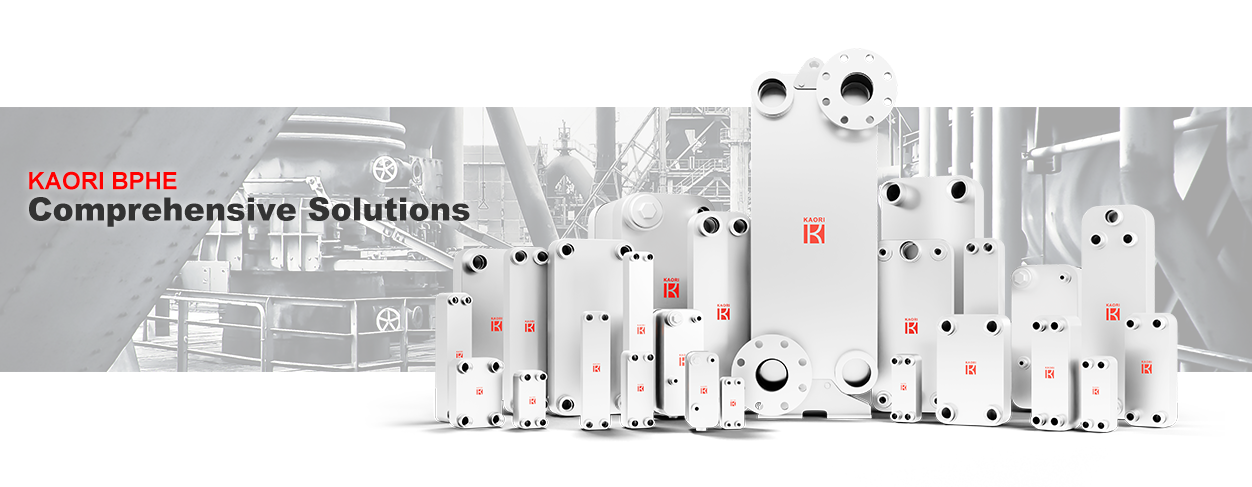
Core Series Analysis: Advantages and Applications of Each Series
1. Sustainable Energy and High-Purity Systems: S Series (All-Stainless Steel Series)
If you are focusing on Green Hydrogen (Power-to-X), Semiconductor Process Cooling, or Deionized Water (DI Water) systems, the S Series is your top choice.
- Product Features: Traditional BPHEs use copper brazing material, which causes copper ion leaching when handling deionized water (DI Water). The S Series utilizes a stainless steel alloy brazing material, achieving an all-stainless steel structure.
- Applications:
- Hydrogen Energy Industry: Suitable for temperature control of PEM and AEM electrolyzers, as well as hydrogen system cooling applications.
- Semiconductor Process: Precision cooling in wafer foundry processes and thermal management of laser cutting equipment.
- Fuel Cells: Serving as the core component of heat recovery systems.
2. Natural Refrigerant Energy-Saving Systems: B Series (Asymmetric Design) & R Series (Micro-channel Design)
Driven by ESG trends and environmental regulations, low GWP (Global Warming Potential) refrigerants such as R290 (Propane) have become mainstream.
- B Series: Features an original "asymmetric plate design" that optimizes the channel volume ratio between the water side and the refrigerant side.
- Benefits: Reduces refrigerant charge by up to 44% and lowers water-side pressure drop by 25% (depending on system conditions).
- R Series: Optimized with a micro-channel design to achieve extremely high heat transfer density within a minimal volume.
- Applications: Commercial plug-in refrigeration equipment, Air Source Heat Pumps (ASHP), and liquid cooling for Battery Energy Storage Systems (BESS).
3. Extreme High-Pressure Environments: C Series (CO2 Dedicated Series)
Specially developed for the R744 (CO2) natural refrigerant to handle the extreme pressures of transcritical cycles.
- Pressure Resistance: Bilateral working pressure up to 140 bar, providing reliable safety under high-pressure operations.
- Design Advantages: Patented plate design eliminates the need for additional external frame reinforcement, maintaining excellent structural reliability even under high-pressure cycling conditions.
- Applications: Convenience store CO2 transcritical refrigeration units and industrial-grade cascade systems.
4. Dual Protection for Safety: D Series (Double Wall Series)
For certain applications that strictly require fluids not to mix, the D Series is the best insurance.
- Operating Principle: Utilizes double-wall plate stacking technology. When one plate layer experiences fatigue or corrosion failure, the fluid is directed to external leakage ports to be discharged, rather than entering the other side's channel.
- Applications: Potable hot water systems and precision pharmaceutical processing.
5. Extreme High Temperature and Waste Heat Recovery: T Series (High-Temperature Series)
Targeting high-temperature waste heat recovery and high-temperature energy applications such as SOFC/SOEC, Kaori has developed the highly heat-resistant T Series.
- Technical Data: Uses high-nickel alloy brazing material, suitable for high-temperature application environments up to 900°C.
- Applications: Solid Oxide Fuel Cells (SOFC) and industrial furnace high-temperature gas recovery.
6. Industrial and Specialized Fields: K, Z, M, A Series
- K Series: Versatile standard type with the most complete specifications, the preferred choice for replacing traditional shell-and-tube heat exchangers.
- Z Series: "Large diagonal flow" design developed for large flow rate requirements, suitable for large commercial heat pumps and Data Center liquid cooling CDUs.
- M Series: Anti-corrosion solution developed for high chloride ion environments (e.g., seawater, swimming pools).
- A Series: Dedicated for Air Dryers, integrating pre-cooling, evaporation, and air-water separation in a 3-in-1 compact design.
Kaori BPHE Full Series Technical Specifications Overview
| Series | Technical Positioning | Brazing Material | Max. Working Pressure | Features |
|---|---|---|---|---|
| K Series | Industrial Standard | Copper / Nickel | 45 bar | Standard type, most complete specifications |
| B Series | Asymmetric High-Efficiency | Copper | 45 bar | Saves refrigerant, low pressure drop, preferred for R290 systems |
| R Series | Micro-channel High-Efficiency | Copper | 45 bar | Micro-channel design, extremely high heat transfer efficiency |
| C Series | Ultra-High Pressure Dedicated | Copper | 140 bar | Specially developed for R744 (CO2) systems |
| S Series | All-Stainless Steel Copper-Free | Stainless Steel Alloy | 20 bar | Copper-free alloy brazing, suitable for hydrogen energy and semiconductors |
| T Series | Extreme High-Temperature Heat Resistant | Nickel | 10 bar | Temperature resistance up to 900°C, suitable for SOFC/SOEC |
| D Series | Double Wall | Copper | 45 bar | Prevents fluid mixing, equipped with leakage detection mechanism |
| Z Series | Large Diagonal Flow | Copper | 45 bar | Suitable for large flow, low temperature difference Data Center CDUs |
| A Series | Air Dryer | Copper | 16-30 bar | Integrated 3-in-1 structure, built-in air-water separator |
| I Series | Impact Resistant | Copper | 30 bar | Reinforced structure to handle system water hammer or pressure fluctuations |
Frequently Asked Questions (Q&A) About Kaori Plate Heat Exchangers
Q1: What is the essential difference between choosing the S Series and the K Series in semiconductor cooling systems?
This depends on your cooling medium. If it is just a standard PCW (Process Cooling Water) loop, selecting the K Series will achieve excellent economic benefits. However, if you are using deionized water (DI Water) or strictly need to ensure no copper ion leaching, it is recommended to choose from the S Series or the nickel brazed series; both can prevent metal ion leaching issues in pure water environments. Between these two copper-free solutions, the S Series not only maintains extremely high purity but also offers better cost advantages than nickel brazing, making it the preferred solution balancing performance and economy.
Q2: Why can the B Series (asymmetric plates) save refrigerant charge volume?
The volume ratio of the refrigerant channel to the water-side channel in traditional plates is 1:1, but the heat exchange density of refrigerant is much higher than that of water. Kaori's B Series shrinks the refrigerant channel through an asymmetric design while maintaining a large water-side space. This not only makes the system more environmentally friendly (reducing charge by 44%*), but also lowers water pump power consumption.
*(Depending on system conditions)
Q3: Does Kaori provide selection support for different types of refrigerants (such as R290, R32, R410A)?
Yes. Kaori has developed dedicated Selection Software. Users simply need to input the refrigerant model, flow rate, inlet/outlet temperature, and pressure requirements, and the software will automatically calculate the most suitable configuration from hundreds of models. Feel free to contact the Kaori sales team to obtain the selection software and technical support.

